
Peace Family,
Here’s the Rundown: when someone nearby searches for what you do, Google picks three businesses to put in the box at the top of the page. It weighs three plain things, you control two of them, and most owners I talk to have never opened either.
The three levers: what Google weighs
That box at the top, three businesses and a map, is where the readiest customers land. Google says how it fills it: how well your card matches what was typed, how close you are, and how much it trusts you [1].
The input the experts rank first is the category on your card: a survey of 47 of them scored 187 ranking factors, and the main category came out on top [2]. A tree service filed under “Landscaper” is missing from the searches that pay. The rest of the card adds to that: people are 70% more likely to visit a business whose card is filled all the way in [3].
The encouraging part: only about 1 in 3 businesses holds one of those seats [4]. The box is winnable. Most of your competitors aren’t in it either.
Storm country: what this means for a real crew
In storm country those competitors’ seats change hands fast. St. Louis gets thunderstorms 40 to 50 days a year [5]. Each one puts somebody on their phone typing “emergency tree removal” and their suburb while staring at a limb on the fence.
The crew that gets that call is the one whose card says “Tree service” in the right slot, shows the right suburbs, and has a review from this month. The crew that does better work, but set its card up once years ago, loses this round.
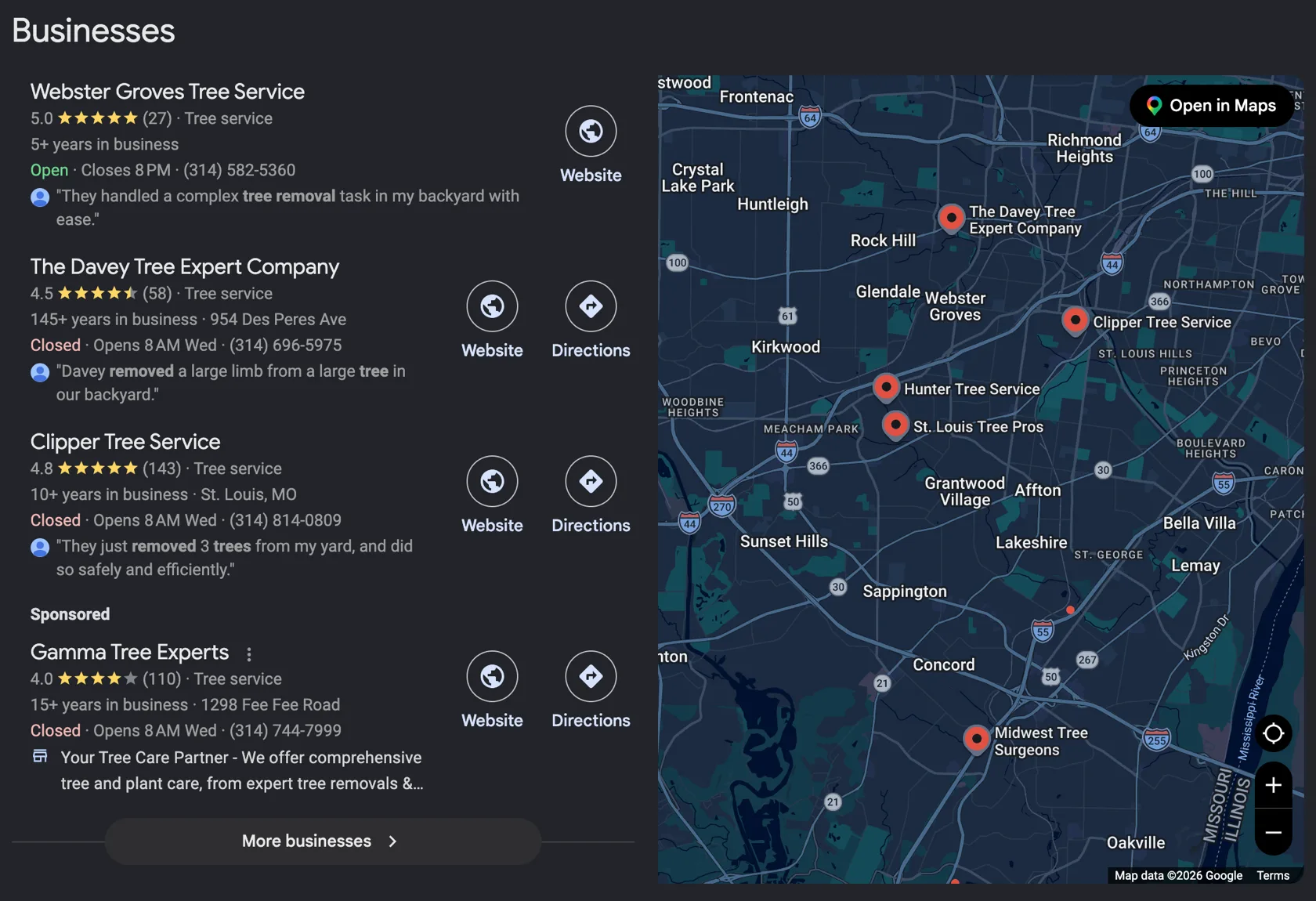
The real box for “tree removal Webster Groves,” captured the day this was written. Every lever in this post fights for one of those three seats.
We’ve all watched a spot everyone loved close while a worse one up the street stayed busy. The difference usually isn’t the food or the work. It’s infrastructure: a findable card, a site that works on a phone, a number Google trusts. That’s fixable, & fixing it for homegrown St. Louis businesses is meaningful work.
The fix: check where you stand, free
The work starts with three checks, free:
- Search your service plus your suburb in a private browser window. Are you in the box?
- Open your own card and read the main category out loud. Is it exactly what you sell?
- Check your hours, services, photos, and the date on your newest review.
That check is yours, free. What it can’t tell you is the order: which fix moves your revenue first, and which are wasted hours. I can’t promise a ranking, and nobody honest will; Google owns these rules. What I can do is show you where you stand and what to fix first: a consultation, $125 for the hour, and you leave with the list whether or not you hire me afterward. I’m taking on my founding St. Louis clients right now; the service and its prices are posted plainly at St. Louis SEO consultant.
The Google Business Profile checklist covers the card work.
I hope this helps.
Sources
- support.google.com · Google’s local ranking guidance: relevance, distance, prominence
- whitespark.ca · 2026 Local Search Ranking Factors: primary category ranked first, proximity second
- support.google.com · 70% more likely to visit a business with a complete profile
- prnewswire.com · SOCi 2026 Local Visibility Index: 35.9% of businesses hold a 3-pack spot
- weather.gov · NWS St. Louis climatology: thunderstorms 40 to 50 days a year